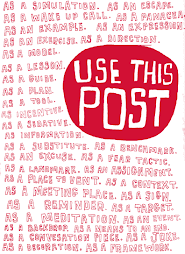
Dang. I don't like this post.
I don't like this revelation.
If acronyms drive me bonkers - because I have to stop and look them up, or ask someone, or go on misinformed, if they drive me crazy enough that I feel the need to write about them, I need to consider what I do that drives others bonkers when I communicate.
Big red flag.
h e l l o . . .
I don't capitalize. I know it drives people nuts. I think I have good reason to not. But now I know better. I know that good communication is better than my reasoning.
Enough said.
This stinks.
Hope you all are happy.
monika
I'm keeping my name lower case. At least for 3 more years.
Tuesday, September 15, 2009
acronyms

after spending the day with some smart people in ed - i had a huge revelation.
acronym = assumes too much.
why do we use acronyms anyway.
to be catchy?
to remember stuff?
maybe to shorten our work load - easier than rattling off long words over and over - and we are busy people....
twitter only holds 140 characters....
all good reasons - but i'm thinking they all stink as well. i can say that - i'm guilty of worse. stay tuned.
in most ed conversations - we swim in discussions on how to get more people involved in change. but if we really cared about those people getting involved in change - we wouldn't put up roadblocks. we'd make things as user friendly as possible.
acronyms are not user friendly. maybe they are for the people using them ... but how does that help? they can talk more - about trying to get more peers involved?
if we really want change. if we really want peers to join in - let's communicate that. let's not separate our conversations into - those that get the acronym and those that don't.
if we need the acronym to remember stuff - great - just use a link to the real meaning when communicating with others.
if we think we need the acronym for tweeting under 140 - send 2 tweets.
the person you are trying to convince - shouldn't be the one that has to look up or ask for definitions


pd
 on pd (professional development)
constantly drowning in a sea of acronyms. sorry i just inadvertently just threw some more water in.
so currently i am participating in 4 online courses:
verizon's thinkfinity
book study course through our school of blogs, wikis and podcasts, by will richardson
alec couros's (social media and open ed)
and
cck09 (connectivity and connectivism)
crazy?
maybe.
just wanting to see what is out there first hand. i wrote a bit a while back about suggestions for pd (it's ok now it was spelled out already). curious if my suggestions were sound.
so - free online courses for tic credit? do i still think that should happen?
well - from my experiences with these (and other) online courses...if i were admin - i would want the teachers in my building/district to have this experience in some way. i would want to know that they were getting to experience learning the way we are wanting them to be passing it on to students.
and why for free...
well - teachers are tapped anyway - why add more cost? time is money - they're spending the time - yes?
and how can we be sure they are getting all they can out of it? how do we assess their participation (since that's what the money is supposed to do - right - they pay for people to test them and make them turn stuff in)?
i have 2 ideas for that:
1. in order to get credit - the teacher needs to convince another teacher to take a similar course
change reaction - thank you rachel's challenge
or
2. the admin assessing the teacher takes the course with, ongoing conversations would assess the level of learning/participation.
please note: i'm not saying that true ed leaders like alec couros should get no pay. we do need to have conversations about that. what i am saying - is that if @courosa is offering one of his incredibly innovative courses for non-credit/free, admin/etc should be encouraging participation in that. letting each district/building then take on the responsibility for assessing the level of learning that takes place, whether or not the course is taken for credit or for non-credit. redefining our current thinking that money = worthy, free = not worthy.
Sunday, September 13, 2009
every kid a kindle? or not?

could be from lack of exposure/insight/wisdom - but every time i see districts pushing for every kid a kindle - it makes me cringe.
as cool as kindles seem - too close to the boxes we've built for my thinking on where ed should be.
it's a matter of focus i guess. and when i try to focus on what matters most in ed these days - while certainly a player - a web based book doesn't rise to the top. i think we have to pay close attention to and be passionate about unboxing everything.
my current thinking includes every kid with access to some tool that can capture thinking any moment of their day.
flip videos (or phones in most pockets) allow for a student to:
1) create their own assessable product - that others not only can help tweak but also learn from.
thinking in my head on - unboxing ed - is that learning is the driving force. not what i learn or who i learn from, but the actual process of learning. that process should have a relativity for most people. a process that includes tweaking. and we're able to tweak only after we assess.
standardized assessing came out of a need to assure everyone was playing the game right and fair. but that assumes a fixed content. and has evolved into the focus of ed. i believe assessment should come from self/peer evaluation. how you are teaching others - how those around you are doing. what you are thinking about and questioning. how you are finding answers to those questions.
and even more unboxed
2) capture random thinking. dan meyer has been a great inspiration to many here. why assume kids do best when we put them in a room and say - be creative in the next 90 min - or - receive all this info in the next 90 min? imagine kids capturing their natural curiosity in the world - whenever that occurs...bringing it back to class - and sharing their genuine thinking and inquiry.
i worry too about the netbook rage. need has to come before tool choice. netbook doesn't supply some basic needs a high school student would want - ie: video edit...
maybe the thing to watch out for when thinking of getting ed tools - is the phrase "every kid a..."
one size fits all box happening - can't be good for learning.
Saturday, September 12, 2009
boxes..
conversations this week ....
about standards.
about filters.

why does the teacher or the text or cipa get to decide what and when a kid learns?
why shouldn't the focus be simply on this...
if there's something you want to learn...
do you know how to learn it?
do you have the skills to research and organize and share it?
do you know how to learn it?
do you have the skills to research and organize and share it?
no matter what it is....
Monday, September 7, 2009
obama ...clout...and... improving ed (i guess it's all about re-blog)
 great post by will richardon,
 coupled with seth godin's everyday wisdom.
my response to will's post and comments that follow....for what it's worth:
a case of boxed ed if ever. and kids get it. no biggie to them. they are used to waiting till after school hours for rich learning. (not that their isn't great teaching - but it's teaching - pouring in a head - not a kid exploring/learning through inquiry and passion - unboxed.) and it's true - ed has always been this way - but it worked before - because it was a time of knowledge acquisition - so we can deem that the good ole days. memorizing or getting the teacher's/state's agenda - no longer works because it's no longer what's needed.
i love this post will. it's not idealistic. this is an incredible time for ed. if we can just use our resources to create a voice of change. godin blogged today on researching clout. let's do that. let's find our clout and get the job done.
we think it's idealistic or not possible because we're used to linear thinking. the web brings differentiation to infinity for the student. and it brings an exponentially clouting network to provide the voice of your words above.
gosh - i hope we don't miss it.
so - unboxed for you...for any learner....the speech.
ps: my thinking...great speech. i would want any student (that's everyone) to hear it and believe in it.
but for education, this isn't about this particular speech. it's about us giving up the teaching and letting the students own the learning. thank you alan november.
200000 laptops for nsw via re-blog

great video on use of laptops - from kids' perspective.
i ran across this a couple weeks ago - then the link went out. thank you scott mcleod for tracking it down. and for your insight.
re-blog happening

great post on mathematics: the language of life? by dennis richards.
great project for students (we're all students - yes?)
try one of them - or all of them.
thank you dennis for stetching us and helping us make connections.
thank you to all the inspiring minds dennis writes about.
Saturday, September 5, 2009
Sunday, August 23, 2009
how we're starting class this year

inspired by greats like:
bob sprankle's dream - about how school should be,
and alan november's question of who owns the learning,
and steven devijver's drive for visual hygiene,
and wendy drexler's networked student ,
and david truss' insight in the pods are coming,
and lisa nielsen's enrage me or engage me - about how we should be doing school - passion-based,
etc...etc....etc.... (you know)
and most and foremost - by kids - with brilliant, young, fresh, ....energetic minds...
here are 2 ways we are starting out our school year differently:
1. about groupwork: rather than having the teacher pick groups and switch them up every so often, students pick members per their passion, and keep them - hopefully for a life time - their professional learning network,
see here how we are starting out: groups
and here for where we are: hosting our groups
http://talk-ed.ning.com/
2. about textbooks : rather than relying on a book - (no disrespect to written text - but we were looking for something alive and unboxed) - each student will have their own twitter account, with carefully selected people to follow - again per their passion - which will serve as a most brilliant search engine, and - each student will join diigo in order to bookmark all they find from twitter and in order to access the info their classroom coach (that's me) has bookmarked and continues to bookmark for them here
learning is fun, alive, passionate....
school should be too.
yes?
Monday, August 17, 2009

Friday, August 14, 2009
tic and pd

so - i'm a crazy fanatic about learning. ask my colleagues. (i know i annoy some of them.)
thing is - i'm passionate about high school kids, about learning, about spending 7 hours a day (school) wisely. what my colleagues might not get or see is that i'm passionate about them as well. and that's what i'm wrestling with just now.
i feel like i've learned at least the equivalent of a master/doctorate in the last 6 months - through my expert individual tutor and a couple different plns that i feed off of and crave insight from daily. i've listened to webinars on end, engaged in twitter and blog conversations galore, read a kazillion sites and blog posts and articles, several books.....
i'm so pumped for this school year. i believe we are in such an amazing time for education (that's another conversation in itself - like will richardson's post.) bottom line - i want others to feel the same. i want them to see the future as unbelievably open to opportunities we never had before as educators - rather than the overwhelmed feeling i know a lot feel.
going through pd and training and meetings these last two weeks - i've been thinking about all this. wondering if there were ways to reward my admirable brave colleauges for all the extra hours they put in - a way to encourage others to dive into and embrace all the remarkable opportunities we have.
here are some suggestions - (please add more or suggest more or start conversations):
i would like to see these things considered for tic and pd:
1) attendance at webinars - ie: george siemans and dave cormier - social media seminar
2) book clubs (online or off) - ie: mcleod's castle book club
3) online courses/conferences - ie:
*mooc (massively open online course)
*open ed conference ie: just listened to gardner campbell's talk on thinking the unthinkable - and here is dave cormier's post after the conference
*thinkfinity through verizon (nice move verizon)
some of these you can currently get tic for. for example: the thinkfinity course - you can submit the site (preferably 2 weeks before the event) for approval. i got it approved in 2 days. however, verizon offers for FREE - 30 cde hours or for $50 2 college credits from adams state. my approval was only if i went the $50 route.
but i'm thinking - there's got to be a better way. a more meaningul and useful way - to incorporate accountability (rather than paying to prove it.)
some thoughts i have for attaining tic credit after attending a webinar, etc... (listed in order from least to most useful/beneficial:
1. meet with your instructional coach or admin (you should have something you want to share)
2. get a colleague to participate with you and then turn in some form of your rich discussion after
3. do the same as #2 only with someone from your pln (professional learning network)
4. produce a copy of the webinar dialogue (showing your comments/questions) either during or after the event, or the comments from the book club blog sites, etc..
5. add a post on a district (or personal) blog site, so that you gain a rich reflection on the experience and others interested might also gain insight from your experience through ongoing conversations (i'm thinking blog = reflection/conversation)
6. create a wetpaint/wiki workspace to encourage/enable collaborations on some activity/topic you learned about so that others can then use it (i'm thinking wiki = workspace)
will richardson's post today is a must read. we have to let go of the way we've been doing things. we need more people to understand that:
1. this isn't just another trend/cycle/new toy
2. we're missing it
3. the kids lose - but gosh - we do too - why wouldn't any teacher want to crave the next day with his/her students
Wednesday, August 12, 2009
why do we learn? not how or what, but why?

inundated with training and professional development and meetings.
observing behaviors/attitudes/etc of teachers.
conversations around focus.
why are we here: to help kids
what is the purpose of school: to learn how to learn (although today's meeting - achievement - who defines that?)
as i leave these people - my mind wrestles on - why learn?
i'm content.
i have darlings i would love to spend more time with. more time playing. so why this pursuit? why spend so much time learning? what's the purpose. what's my goal.
oh - my goal.
now i remember.
my personal life goal is to help others. i get to keep learning and i must keep learning - if i want to help others.
once i step outside the fishbowl - especially of my family - where - ya - we'd be ok w/o learning any more ---- there are people who do need to learn stuff in order to help themselves. for some - in order to survive.
in the wide world - people need to learn things as drastic as how to get clean water.
in close proximity - people need to learn things as simple as doing school right.
i learn - so that i can help others.
there will always be people who need help.
i will always need to learn more.
and gosh i'm glad there are others who feel the same.
because i so need them - in this helping others pursuit.
thank you to my many tutors/coaches/mentors - for helping me learn.
and thank you @bengrey for nudging me to think this through.
Thursday, August 6, 2009
kid insight...incoming freshmen

there is so much to learn from incoming freshmen. perhaps because they haven't learned to mask their emotions yet? who knows. ...
but i'm watching.
and learning.
what i've learned this week about gatherings...
1 all gatherings need and will have leaders
2 anyone can be a leader, *everyone should be
3 there are generally 3 types of groupings around a gathering:
a: the natural leader and those happy to follow, (including those standing on the edge wanting to join)
b: those thinking they are too good to join
c: those thinking they are not good enough to join
4 a good leader will start a movement, then zoom out, back away, noticing groups b and c. they will realize hidden desires to belong, and start troubleshooting ways to get inner voices heard, roadblocks removed...
*being a leader is not about control or power, it's about gathering and organizing around shared passions. can't think of something you could lead? maybe your not looking in the right places, maybe you're not zooming out, backing away, in order to notice those inner voices with hidden needs and desperate desires to belong.
look at the leader of this community for inspiration....
Saturday, August 1, 2009
there's more

ok - so about my story....
well - i guess there's more. i found more. or more came to me.
on my simplistic life goal - to help others:
as self-sacrificing and noble as it might sound - it really is coming from my need to be needed.
now is that just human nature? jacqueline novogratz writes of this when she tells of working with women in africa - my paraphrase - she says they weren't interested or even in need of her (jacqueline's or acumen's) help as much as they were in need of being needed. while it certainly is human nature - i see two issues with it.
1) if i'm helping you because i need to be needed - but you see me as noble and selfless - that's a deception. i'm not being transparent, perhaps not even to myself. and while - good things may come of it - at the core - it's selfish. perhaps that why the people who appear to be doing the most self-less acts get caught up in so many horrible misdeeds. the hiding of their motive to do good corrupts them even more. their non- transparency is at a much deeper level than scandals - who's selfish acts are most completely exposed. it's like a subliminal non-transparency. it's this fake transparency that is becoming popular today. just enough transparent to encourage trust.
2) if i'm helping you because i need to be needed - the way in which i help you will be guided by my agenda. i will in essence be trying to put you in the box of my perceptions. it's a control issue. ego really is everywhere. dang.
a more helpful approach would be to help you figure out how your dilemma can be resolved. period.
this little revelation - clears a lot up in my head just now. for life, for relationships, for ed, for math, ....
how often - when people need help - do we say - i don't know what to do for them and so to pacify ourselves - we say - they just need someone to listen to. (gosh if we could just leave it there.) but invariably - our "wisdom" gets the best of us and we determine that they do need us to do something. they need us to fix them - so we try to force them into a solution from within our box.
no wonder it seldom works. and if it does - it's short-lived.
stepping out of our box - out of ourselves - is not easy.
for proof
1) we never do it
or
2) take a look at a math class
but we need to start stepping out. we need to start seeing outside of ourselves. we need to realize that it's not my plan to save the world that is going to save the world. the plan has to be our plan. i, me, you, ...has to become us. if it doesn't become us - the plan has no value.
simple sounding - but it's a whole different realm. not so simple to take on.
like in teaching, we get a new tech tool, and we think if we use it - we're on to something. when actually, we're just hiding the truth even more. we're missing the big picture. and in missing the big picture - the tool becomes trite. bad even. because the use of it - for the sake of using it - hides the original mission -learning how to learn. focus is on the tool. focus is on self. focus is on how i perceive education. ..the world. and worse yet - we think we've fixed things. we think we've gotten closer to our goal - when actually we've just fogged up the window. and now - it's hard to even realize that - we're missing it - because of all the fog.
the challenge then becomes - step out of my box daily. quit stuffing the world and the people in the world into my box. notice the world around me in defining the world around me. rather than defining the world by my previously boxed world. no matter how cool or pretty or selfless my box appears.
what i'm thinking now - that's true self-lessness.
and if we all got there - the world could be...- one.
imagine.
soul peace.
Thursday, July 30, 2009
kid insight ...on whining

an issue came up last night with some students.
they had come to a conclusion about the direction a project was going to take. upon diving in - they came across some snaggles. a few started grumbling and soon - at least the loud ones - had decided that they should change the direction of the project. a debate ensued. the loud ones (at least) were divided. more debate- this time however with more listening. finally - a conclusion. and things forged on.
findings:
1) listening to each other is huge to working together
2) letting each voice be heard is different than pleasing each voice
3) a voice needs to speak up - BEFORE - the decision is made, most voices after are a distraction/wasted energy
4) once the decision is made - don't let dips make you doubt your decision. keep testing for sure - but don't change your mind because things get difficult
5) even if you didn't vote for the final decision - creating one voice through your actions is vital to success - so jump in for the good of the cause (if the cause doesn't seem worthy - you're probably in the wrong place)
how often to we let dips rule us (take us places we don't really care to go) rather than letting dips define us (is our character, insight, strength, etc..., enough to get us through dips with no whining.)
we found that dips and whining/debating often stood in the way of action. and often resulted in wasted energy and weary people.
made me think of teacher's meetings and professional development. how much time we spend debating things - rather than doing things. we should take note of the consequences of labeling weakness and whining as listening. listening is hard. we have to listen to what is NOT being said as well. and we have to listen with discernment. not just nodding to please every response. we have to challenge each other to rise above roadblocks. and realize that many of the roadblocks we face are simply - us.
encounter a dilemma.
listen to solutions.
create/determine a solution.
act it out.
filter weak thinking. keep the focus strong.
i love how simple learning can be when you listen.
especially to kids.
Tuesday, July 28, 2009
listen with grace

from a recent conversation with some kool bean student leaders, my thoughts are lingering on how to get people to think more of others than themselves - or as our conversation started - how to be a good leader.
i'm thinking the most important skill needed to be a good leader, is listening.
i read once about blogging, that a blog worth reading is one by a person who reads more than they write. that's listening.
per john gardner in jacqueline novogratz's blue sweater, -we need to find innovations that release the energies of people...focus on supporting others to do what they do well...the goal should be making a difference rather than pleasing others or achieving your own agenda.
this takes grace. decency. we have to care about others more than ourselves. we have to believe that all of us really do want to do good - even though that manifests itself in various ways. if we don't keep this focus, if we don't listen with this mindset - most things people do/say will tick us off. we'll stop listening and start ranting or ignoring or blaming.
when you treat people with grace, when you really listen to them - what they are saying - what they aren't saying - how they are acting - - you unleash powers not only in them but in yourself. relationships give meaning and listening is the beginning of relationship.
once relationship exists, then you can learn/work/play together. helping others to help themselves has to be the greatest gift a leader can give.
this quote from jacqueline's book - says it well,
go to the people:
live with them, learn from them
love them
start with what they know
build with what they have.
but of the best leaders,
when the job is done,
the task accomplished,
the people will say:
we have done it ourselves.
-lao tzu
what power? what empowerment? what better way to lead?
it's not about all the things you can do for people. it's not even about all the things you can do with people. it's about how you do those things. how you treat others. how much you care about others - enough to help them be the best they can be.
so let's listen more.
let's listen with more grace.
let's just see....
happy day

my story -
growing up i always thought i'd be in ithe peace corps. peace...keeping it, sharing it, having soul peace...huge to me.
my life goal - has been to help others. i remember feeling embarrassed more times than not that my goal was so simplistic.
i did really well in "school math" - i did really well in "school" - but only because i played the game well. it wasn't until i started teaching math that i started getting it.
despite my enthusiasm/love for math - kids weren't getting it. in fact - when i walked into other classrooms, incredible teaching was going on - but a lot of kids were not at all engaged.
so began my journey - to address the meaning of the 7 hrs a day kids spend in school. i asked kids constantly, what would help? what would engage you?
as you can imagine - the answers varied. ---- i can't listen to lectures, i need more lectures. i don't like homework, i need more homework. i have test anxiety, i want to just take the tests. i need hands on, i don't like group work.
so ...dilemma.
just about then i joined an online community. and my world grew and shrank all at once.
IT GREW in that my vision expanded. i was now able to work overseas, help people in africa, find out what it's like to live in the uk, in belgium. i was able to interact with people i had no right interacting with. social class disappeared, economic status meant nothing, ed prowess didn't even interfere. relationship and conversation allowed my world to become wide.
IT SHRUNK in that i hooked up instantly with like minds. traveling to the same destination (mentally/emotionally) was a breeze. no more time wasted on triteness and trivialities. we fed off each other like clockwork. some became much needed individual expert tutors. relationship and conversation allowed my learning and my life to become rich.
and then i realized - this was the way to cater to 100+ students' needs.
the coolest thing - i was learning how to become a part of a network that sharpened each other, challenged each other, was transparent with each other, loved each other - all for the sake of learning - for the sake of helping others.
what i've learned from all these interactions - a new take on education - and on my simplistic life goal. education is learning to learn. you learn by helping others. you can reflect to tweak yourself - by paying attention to those around you. how those around you are doing - says how you are doing.
we all have value. we all want to do good. but we are better together.
well - this bit of info is unleashing drive in me - drive i didn't realize i had.
i've gone from a high school math teacher who felt uncomfortable with a graphing calculator, to a math/life coach who's students are creating their own curriculum/hw/tests, mentoring through skype/blogs with middle schools/colleges/businesses and africa (for starters), creating tailored modules/ebooks/projects/videos in order to help others learn math/life, working with wolfram alpha/google squared and graphing calculators....michael wesch has inspired in us a platform on netvibes. i'm listening to my wise peers, like dan meyer, who suggests we - be less helpful, alan november, who asks - who owns the learner, bill strickland, who says we should - look like the solution not the problem, and will richardson, who says personal learning networks are the way to go in ed, we just need to model how to do them 1) safely 2) ethically and 3) efficiently.
my pln model is triiibes.
thank you triiibesters. i can't even start listing names...if you want to hear your name you'll have to listen to my heart.
thank you seth godin.
my model is in what you created. for us.
i'm indebted to you for focus. and exhilaration.

oh - happy day.
despite my enthusiasm/love for math - kids weren't getting it. in fact - when i walked into other classrooms, incredible teaching was going on - but a lot of kids were not at all engaged.
so began my journey - to address the meaning of the 7 hrs a day kids spend in school. i asked kids constantly, what would help? what would engage you?
as you can imagine - the answers varied. ---- i can't listen to lectures, i need more lectures. i don't like homework, i need more homework. i have test anxiety, i want to just take the tests. i need hands on, i don't like group work.
so ...dilemma.
just about then i joined an online community. and my world grew and shrank all at once.
IT GREW in that my vision expanded. i was now able to work overseas, help people in africa, find out what it's like to live in the uk, in belgium. i was able to interact with people i had no right interacting with. social class disappeared, economic status meant nothing, ed prowess didn't even interfere. relationship and conversation allowed my world to become wide.
IT SHRUNK in that i hooked up instantly with like minds. traveling to the same destination (mentally/emotionally) was a breeze. no more time wasted on triteness and trivialities. we fed off each other like clockwork. some became much needed individual expert tutors. relationship and conversation allowed my learning and my life to become rich.
and then i realized - this was the way to cater to 100+ students' needs.
the coolest thing - i was learning how to become a part of a network that sharpened each other, challenged each other, was transparent with each other, loved each other - all for the sake of learning - for the sake of helping others.
what i've learned from all these interactions - a new take on education - and on my simplistic life goal. education is learning to learn. you learn by helping others. you can reflect to tweak yourself - by paying attention to those around you. how those around you are doing - says how you are doing.
we all have value. we all want to do good. but we are better together.
well - this bit of info is unleashing drive in me - drive i didn't realize i had.
i've gone from a high school math teacher who felt uncomfortable with a graphing calculator, to a math/life coach who's students are creating their own curriculum/hw/tests, mentoring through skype/blogs with middle schools/colleges/businesses and africa (for starters), creating tailored modules/ebooks/projects/videos in order to help others learn math/life, working with wolfram alpha/google squared and graphing calculators....michael wesch has inspired in us a platform on netvibes. i'm listening to my wise peers, like dan meyer, who suggests we - be less helpful, alan november, who asks - who owns the learner, bill strickland, who says we should - look like the solution not the problem, and will richardson, who says personal learning networks are the way to go in ed, we just need to model how to do them 1) safely 2) ethically and 3) efficiently.
my pln model is triiibes.
thank you triiibesters. i can't even start listing names...if you want to hear your name you'll have to listen to my heart.
thank you seth godin.
my model is in what you created. for us.
i'm indebted to you for focus. and exhilaration.
oh - happy day.
for latest revelation....and there's more
and latest thoughts on what public ed should be
Saturday, July 25, 2009
more thoughts on school and boxes

just read these two pieces – seeking more insight from you all. aren’t these two conversations similar? interestingly similar? two different eras – but aren’t they saying the same thing… about boxes….
@danah boyd I desperately, desperately want my colleagues to be on IM or IRC or some channel of real-time conversation during meetings. While I will fully admit that there are times when the only thing I have to contribute to such dialogue is snark, there are many more times when I really want clarifications, a quick question answered, or the ability to ask someone in the room to put the mic closer to the speaker without interrupting the speaker in the process.
I have become a “bad student.” I can no longer wander an art museum without asking a bazillion questions that the docent doesn’t know or won’t answer or desperately wanting access to information that goes beyond what’s on the brochure (like did you know that Rafael died from having too much sex!?!?!). I can’t pay attention in a lecture without looking up relevant content. And, in my world, every meeting and talk is enhanced through a backchannel of communication.
@richard feyman This man also speaks about a new institution, in a talk in which he was resigning as Director of the Institute of Parapsychology. And, in telling people what to do next, he says that one of the things they have to do is be sure they only train students who have shown their ability to get PSI results to an acceptable extent— not to waste their time on those ambitious and interested students who get only chance results. It is very dangerous to have such a policy in teaching—to teach students only how to get certain results, rather than how to do an experiment with scientific integrity.
two fears i get from the topics of this post - not from the people commenting or the content - just of the topics. (and by fears – i don’t mean – gosh what if i can’t answer the questions my kids pose, or fears like tim ferriss addresses – but rather – fears of claustrophobia a box brings.)
1) mandates: any use of the word mandate in education. if – because we are an institution, we are mandated to use the word mandate, then let’s use it like this – let’s mandate that kids learn how to learn. isn't any other mandate is building a box?
2) division: any talk of division, separating “us.” the blue sweater by jacqueline novogratz, is steeped in insight for ed. especially ch 5, the blue bakery. from my take on newbies – very similar to the impoverished rwandans. she writes: “the story of the bakery was one of human transformation that comes w/being seen, being held accountable, succeeding.”
i’ve spent so much time in the classroom trying to get the “impoverished/newbies” to let their voice be heard. to convince them that every voice is key to our journey. it makes me cringe to think we aren’t modeling that. @dean @bengrey – dan meyer is a great example.
unboxed. together. we are more.
Friday, July 24, 2009
why students don't like school

i was in scott mcleod's book club this summer.
we read why students don't like school by daniel willingham.
the last post for the club - takeaways.
interesting - a lot of smart people upset that the question in the title wasn't answered. here's my take on that takeaway please know that i'm talking to myself first...
1) it's funny how all the things we complain about the most in kids - are the things we are the worst at. if we want them to get it - we have to get it (model it) as well.
2) it's also funny that as teachers we talk a lot about cycles - meaning - been there done that. so now i'm wondering if we've really "done that" - i'm wondering if we've even "been there."
why do cycles seem to appear? perhaps we aren't getting it right the first time. for instance - we've tried discovery learning and groups - oh so many times. well - after being bashed and failed by so many - they appear to be back - in the guise of plns personal learning networks and pbl project based learning.
and with the web - both have become so much more - just saying.
3) i think this book frustrated people because they were looking for a quick fix answer. which translates - we want to be spoon fed. we often comment - if kids were self-regulated, self-advocates..., all my problems would be solved. well - what about us? where do you think they learned the whole "spoon fed" approach. come to my class - learn this - so i can test you on this. that's not teaching them to learn. it's teaching them how to take tests. my takeaway - kids would like school if the teachers modeled learning...
first steps
by the way - true learning doesn't need a plug - if it's true - the energy of it "happening" will generate the public/community.
1) LEARN STUFF - become active in a pln (off or online) quote from @timwhitby - motivational speakers may motivate educators to feel good about teaching, but a good PLN motivates them to feel good about learning.
2) TWEAK YOURSELF - reflect on a frequent/regular basis - so that your learning stays fresh and can sustain
from @ddmeyer assessments should be ongoing - not end of unit freak out time.
seem overwhelming? a bit scary....
well - boxes are safe. but hey - you're in a box.
once you get going - you'll wonder what took you so long.
Subscribe to:
Posts (Atom)