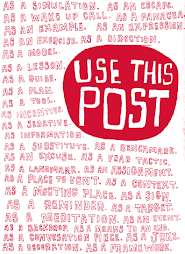
and it got me here:
the more people are tempted
to click away from your content,
the more they want to keep
coming back.
and i'm thinking - that's how school should be.
we should be about making kids hungry to learn more.
and we do that by letting them go.
(here comes cake again.. let me go and i will love you more.)
i love it.
so - here's where i started:
bud hunt
then i linked here
which reminded me of this (will they come back from that?)
and this (are we facilitating ways to filter) and this
_________________________________________________________
Sunday, October 10, 2010
Saturday, October 9, 2010
danah boyd
Broadcast media structures (schools) take one critical thing for granted:

There is an assumption that everyone will tune in and give their attention to the broadcast entity. Yet that has never been true.
With the barriers to distribution collapsing, what matters is not the act of distribution, but the act of consumption. Thus,
the power
is no longer in the hands of those
who control the channels of distribution;
the power is now in the hands of those
who control the limited resource of attention.
This is precisely why Time magazine's Person of the Year for 2006 was "You."
Your attention is precious and valuable. It's no longer about push; it's about pull.
And the "Law of Two Feet" is now culturally pervasive.
{isn't this what people are calling web 3.0}
Being in flow with information is not about being interrupted
Switching from a model of distribution to a model of attention is disruptive, but it is not inherently
democratizing.
At the most basic level, consider the role of language. People will pay attention to content that is in their own language, even if they can get access to content in any language. (global voices, zuckerman, translating tweets and wikipedia in other languages)
If we're not careful, we're going to develop the psychological equivalent of obesity.
We're addicted to gossip - what's the alcohol
making it work:
we have yet to find the digital equivalent of alcohol.
Figuring out how to monetize sociality is a problem, and it's not one that's new to the Internet. Think about how we monetize sociality in physical spaces. The most common model involves second-order consumption of calories. Venues provide a space for social interaction to occur, and we are expected to consume to pay rent. Restaurants, bars, cafes—they all survive on this model. But we have yet to find the digital equivalent of alcohol.
____________________________
isn't - transparency - the new currency?..
and through authentic and non agenda driven transparency -
s h a r i n g occurs.
bring on the mesh... let's drink it up.
danah will be embedded in my mind forever for a comment i was lucky enough to hear a year or two ago - that she focuses on going where the clusters are - and figuring out why they're clustering..
i've been listening to and watching people (mostly kids) for several years now... trying to do that. trying to notice things. things that matter.
i realize this sounds utopian, but i do believe we are primed for sharing - people are craving a simpler more honest time.
and the gang who is now gradeschool through college - seems to have that as second nature. the ways they display it (in a system with so many rules sharing has no air to breathe) tend to manifest in atypical ways. but when you take the time to listen to their story... a lot of what we see and interpret incorrectly is a defense mechanism they have built up.
in fact - from my perspective - (one that is earnestly seeking out those global voices) - i'm blown away by what kids put up with today... in a relatively respectable manner.
if we could unleash this in public school. take away those suffocating rules.. ed could be the vehicle to social change.
and like - overnight even... because so many are primed... and because networking can. that fast.
_________________________________________________

There is an assumption that everyone will tune in and give their attention to the broadcast entity. Yet that has never been true.
With the barriers to distribution collapsing, what matters is not the act of distribution, but the act of consumption. Thus,
the power
is no longer in the hands of those
who control the channels of distribution;
the power is now in the hands of those
who control the limited resource of attention.
This is precisely why Time magazine's Person of the Year for 2006 was "You."
Your attention is precious and valuable. It's no longer about push; it's about pull.
And the "Law of Two Feet" is now culturally pervasive.
{isn't this what people are calling web 3.0}
Being in flow with information is not about being interrupted
Switching from a model of distribution to a model of attention is disruptive, but it is not inherently
democratizing.
At the most basic level, consider the role of language. People will pay attention to content that is in their own language, even if they can get access to content in any language. (global voices, zuckerman, translating tweets and wikipedia in other languages)
stimulation.
If we're not careful, we're going to develop the psychological equivalent of obesity.
We're addicted to gossip - what's the alcohol
homophily.
In an era of networked media, we need to recognize that networks are homophilous and operate accordingly. (and now zuckerman)power.
We found that reasonable people disagreed about which accreditation method was best. making it work:
we have yet to find the digital equivalent of alcohol.
Figuring out how to monetize sociality is a problem, and it's not one that's new to the Internet. Think about how we monetize sociality in physical spaces. The most common model involves second-order consumption of calories. Venues provide a space for social interaction to occur, and we are expected to consume to pay rent. Restaurants, bars, cafes—they all survive on this model. But we have yet to find the digital equivalent of alcohol.
____________________________
isn't - transparency - the new currency?..
and through authentic and non agenda driven transparency -
s h a r i n g occurs.
bring on the mesh... let's drink it up.
danah will be embedded in my mind forever for a comment i was lucky enough to hear a year or two ago - that she focuses on going where the clusters are - and figuring out why they're clustering..
i've been listening to and watching people (mostly kids) for several years now... trying to do that. trying to notice things. things that matter.
i realize this sounds utopian, but i do believe we are primed for sharing - people are craving a simpler more honest time.
and the gang who is now gradeschool through college - seems to have that as second nature. the ways they display it (in a system with so many rules sharing has no air to breathe) tend to manifest in atypical ways. but when you take the time to listen to their story... a lot of what we see and interpret incorrectly is a defense mechanism they have built up.
in fact - from my perspective - (one that is earnestly seeking out those global voices) - i'm blown away by what kids put up with today... in a relatively respectable manner.
if we could unleash this in public school. take away those suffocating rules.. ed could be the vehicle to social change.
and like - overnight even... because so many are primed... and because networking can. that fast.
_________________________________________________


mesh
reading lisa gansky's mesh.

perhaps we are moving into an era when feeling secure and happy will be uncoupled from what we individually own.
used to be that autonomy and excess was our status
now perhaps civic behavior and community is coming aback around...
oh yay.
p. 71ish.
___________________________________
perhaps we are moving into an era when feeling secure and happy will be uncoupled from what we individually own.
used to be that autonomy and excess was our status
now perhaps civic behavior and community is coming aback around...
oh yay.
p. 71ish.
___________________________________
story
currently, i'm seeing less and less value in blame, judgement, labels, rules, reward, ..
(and while i read that over and think.. no duh... that is where we spend most of our time and energy)
so what if we shifted our mindset (and our actions) and started believing that these are all just info. bits of info. info out of context.
so yes - notice them, use them... most of them are habit now in most of us - so they won't be hard to notice.
but let's start using them only as info, rather than defense or security or whatever...
if they're info...we should be seeking the context - right?
the story.
if we spend more time noticing, seeking out, being mindful of - stories - i believe we will be the change our souls are seeking.
what if - loveland became the town that no longer reacted, but listened to stories.
what if - colorado became the state that no longer reacted, but listened to stories.
what if - the us, ....the world became the place where no one simply reacted, but we listened to stories.
funny - (at least as i see it in my head just now) the time we're in isn't a simple spiral cycle .. it's not like if we wait - it will come back around. because the benefits and opportunities we face now - are the result of one large spiral from thousands of years ago... when people listened to stories.
we have come full cycle... through building a lot of cool things, learning a lot of cool facts, getting a lot of cool stuff.
so much that we're finding out - what that got us was,
... lots of cool things and facts...
and what we've left behind is
... people and stories.
(this is a generalization and extreme - i know there are many people out there that this doesn't apply to - they teach me daily- i need detox as much as anyone.)
Jesse (at dm&l meeting) spoke of how the calculator freed us up from the details of math to get to the matters of math. much the same is happening today in regard to learning.
community is indeed the curriculum.
people and stories.
in one of Seth Godin's interviews... at the end he's asked... so what's next.
and he replies...
now is next. this is next.
so let's do it.
_______________________________________
(and while i read that over and think.. no duh... that is where we spend most of our time and energy)
so what if we shifted our mindset (and our actions) and started believing that these are all just info. bits of info. info out of context.
so yes - notice them, use them... most of them are habit now in most of us - so they won't be hard to notice.
but let's start using them only as info, rather than defense or security or whatever...
if they're info...we should be seeking the context - right?
the story.
if we spend more time noticing, seeking out, being mindful of - stories - i believe we will be the change our souls are seeking.
what if - loveland became the town that no longer reacted, but listened to stories.
what if - colorado became the state that no longer reacted, but listened to stories.
what if - the us, ....the world became the place where no one simply reacted, but we listened to stories.
funny - (at least as i see it in my head just now) the time we're in isn't a simple spiral cycle .. it's not like if we wait - it will come back around. because the benefits and opportunities we face now - are the result of one large spiral from thousands of years ago... when people listened to stories.
we have come full cycle... through building a lot of cool things, learning a lot of cool facts, getting a lot of cool stuff.
so much that we're finding out - what that got us was,
... lots of cool things and facts...
and what we've left behind is
... people and stories.
(this is a generalization and extreme - i know there are many people out there that this doesn't apply to - they teach me daily- i need detox as much as anyone.)
Jesse (at dm&l meeting) spoke of how the calculator freed us up from the details of math to get to the matters of math. much the same is happening today in regard to learning.
community is indeed the curriculum.
people and stories.
in one of Seth Godin's interviews... at the end he's asked... so what's next.
and he replies...
now is next. this is next.
so let's do it.
_______________________________________
Friday, October 8, 2010

Thursday, October 7, 2010
reggio inspired
The room was filled with evidence of another key element of a Reggio- inspired education: extensive displays of the children's work and descriptions of that work in the children's own words. There were butterflies made of paper and caterpillars made of wool. A little girl named Caroline had written, ''I made a ring space bracelet.''
The Reggio approach places heavy emphasis on documentation.'In education, there is often a problem that teachers focus on what they like to teach and they are not focusing on what the children like learning,'' said Dr. Spinelli, who has been the school's director for 24 years. ''When you document their learning, you know where their thinking is.''
______________________________________________________
the personalized high school

18% getting a degree for what is 32% of job market
32% of workforce has a ba or higher
number of reasons to redesign hs - not many are heading to college
steve: this tells me now how finland does it
8 practionars telling a bout a diff way of learning
idea was to allow innovative educators tell their story
advisor for each kid
personal learning plans
career like explorations, imagining life beyond high school
2) making learning personal
changing practices:
project based learning - go deep into something they're passionate about
ch 4: school diane likes - influence of hope and optimism on outcomes/future
piece of assessment - catherin delora - previous principal of school in ny
Moderator (Joe DiMartino): No other country awards credit based on the amount of time spent in class
linda nathan in boston - create prof learning culture
create plc's
final chapter - jeff parkhurst - front range ... in denver - big picture school - whole met model - learning through internships
jackiegerstein: Chucagh Alaska School district also did an amazing job revamping their whole district - from scratch bringing teachers, parents, community members together to develop the system remarkable results - http://www.chugachschools.com/
50-60 big picture schools than maybe 100's others that have decided to personalize learning
but not 1000's out of about 20000 high schools
joedimartino@cssr.us
intentionally asked teachers to tell stories of how to
granger 400 students, 90% poverty, high crime rate, murder in the school
wanted to divide out the trouble makers to he divided the kids into groups of 18 - teacher met with them 4 times a week for 30 min... creating career plan, twice a year - a student led conference - student presented their career plan to parents. most hs's have fewer than 10% of parents come in
after one year - 100% of parents came in
Moderator (Denise Wolk 2): It is easy to think about what's going on with adults, but when we focus on students and their interests and needs, learning can be powerful
he said could do this 20 to 1 in any size school.
so every student can relate to one adult
it's about getting to know students
shift from direct instructor to facilitator
relationship building is cool
http://www.slideshare.net/GerryC/personal-learning-plan-template
for making advisories: http://www.alliance.brown.edu/pubs/changing_systems/power_of_advisories/
not all are charters in this book
short attention span theatre - we need to slow down - think about our kids - take the best of all these great ideas
if joe were in charge he would change to performance assessment
students do things in their interest - and present it to a critical panel
if denise were - supporting educators to make those changes
her son graduated hs with 4 certificates in welding..
end of each chapter - list of resources
For more information you can also contact me: dwolk@esrnational.org or Joe at joedimartino@cssr.us
national school of secondary principals
www.essentialschools.org
hs showcases
www.cceo.us
www.principals.org - NASSP
http://www.ascd.org/about-ascd.aspx
http://www.vlacs.org/
Moderator (Denise Wolk 2): Educators for Social Responsibility www.esrnational.org
Moderator (Denise Wolk 2): Center for Secondary School Redesign www.cssr.us
no correlation between
success on ap and
success in college
but correlation between
success on ap and
admission to college
personalized school practice
p. 50
harder than changing the structure is changing the culture
the culture should be focused on the students
finland - not tested as much as our kids more focus on depth less on coverage
and - this from ivanasendecka earlier today: http://bit.ly/a9Hphi what say you ,Mon on @LETSREDU ?
______________________
dan gilbert
Dan Gilbert, author of Stumbling on Happiness, challenges the idea that we’ll be miserable if we don’t get what we want. Our "psychological immune system" lets us feel truly happy even when things don’t go as planned.
one of his slides:

_________________________________________________
one of his slides:

_________________________________________________
Wednesday, October 6, 2010
Monday, October 4, 2010
the mesh

currently reading
combo of shirky's cognitive surplus, godin;s linchpin, the lab, hans rosling's leveling out, zuckerman's global voices, etc...
lisa gansky @instigating
__________________________________
Sunday, October 3, 2010

myelin - the new measure
daniel coyle's talent code:
leaning into the air,
finding
& fixing the mistake
-at the core.
growing myelin - the new monitor for success.
__________________________
leaning into the air,
finding
& fixing the mistake
-at the core.
growing myelin - the new monitor for success.
__________________________
Saturday, October 2, 2010
web 3.0
super video via @kraykray
Web 3.0 from Kate Ray on Vimeo.
bravo Kate Ray... excellent... excellent... down to the music, the spanish translation... bravo.
liked this keen comment as well:
It's a tricky issue, since I see your argument that not including women perpetuates a stereotype in the minds of people watching, but including women specifically for their gender perpetuates a pattern of unequal treatment.
Here's my opinion on the issue:
Since I'm now co-founding an Internet based start-up (an area that's 92% male, according to NYTimes), I'd consider myself a 'woman in tech,' and am acutely aware that it makes a difference.
I would absolutely encourage more women to get into the tech industry. If all my plans and dreams came true with this start-up and I was suddenly very successful, I would scream of out frustration if, after all that, I were profiled in the NYTimes or somewhere else JUST because I was a woman (unless the article was about female entrepreneurs). I wouldn't want to be interviewed for anyone's project as the token female. It would make me feel cheapened.
last quote: if we end up building all the things i could imagine we will have failed.
________________________________
Web 3.0 from Kate Ray on Vimeo.
bravo Kate Ray... excellent... excellent... down to the music, the spanish translation... bravo.
liked this keen comment as well:
It's a tricky issue, since I see your argument that not including women perpetuates a stereotype in the minds of people watching, but including women specifically for their gender perpetuates a pattern of unequal treatment.
Here's my opinion on the issue:
Since I'm now co-founding an Internet based start-up (an area that's 92% male, according to NYTimes), I'd consider myself a 'woman in tech,' and am acutely aware that it makes a difference.
I would absolutely encourage more women to get into the tech industry. If all my plans and dreams came true with this start-up and I was suddenly very successful, I would scream of out frustration if, after all that, I were profiled in the NYTimes or somewhere else JUST because I was a woman (unless the article was about female entrepreneurs). I wouldn't want to be interviewed for anyone's project as the token female. It would make me feel cheapened.
last quote: if we end up building all the things i could imagine we will have failed.
________________________________
stephen heppell
be very afraid
you're just going to show your stuff off as best you can...
best of all - tell them about how you did it..
it's called be very afraid because it's way beyond what your curriculum, college, etc expects of you.
you're changing the world...
via Lisa Gansky
_________________________________-
you're just going to show your stuff off as best you can...
best of all - tell them about how you did it..
it's called be very afraid because it's way beyond what your curriculum, college, etc expects of you.
you're changing the world...
via Lisa Gansky
_________________________________-
Friday, October 1, 2010
clear desk
2. Process this pile from the top down. Never re-sort, never skip a single piece of paper, never put a piece of paper back on the pile. Do what needs to be done with that paper, and then move on to the next in the pile. The options:
trash it,
delegate it,
file it,
do it,
or put it on a list to do later.
In that order of preference.
Do it if it takes 2 minutes or less to complete.
If it takes more, and you can’t trash, delegate or file it, then put it on a list of to-dos (more on your to-do list in another post).
via clear desk
mind like water
______________________________________
trash it,
delegate it,
file it,
do it,
or put it on a list to do later.
In that order of preference.
Do it if it takes 2 minutes or less to complete.
If it takes more, and you can’t trash, delegate or file it, then put it on a list of to-dos (more on your to-do list in another post).
via clear desk
mind like water
______________________________________
Subscribe to:
Posts (Atom)