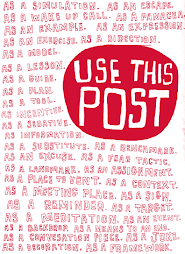
Thursday, December 16, 2010
seth godin
CURIOSITY from Nic Askew on Vimeo.
curious has nothing to do with income or education.. has everything to do with a desire..
it's easy to underestimate how difficult it is for someone to become curious...
safest thing you can do is play it risky, the riskiest thing you can do is play it safe
____________________________________________


Wednesday, December 15, 2010
kiran bedi
concept of mindfulness
crime is a product of distorted mind
police (adults, etc) are equally a prisoner of their minds
anti-corruption movement in india
________________________________
diana laufenberg
we live right now with an infatuation to fill in one right answer on a bubble test
to tell kids to always have the right answer does not allow them to learn
i gave them the room to go figure it out
experiental learning
student voice
embracing failure
____________________________________
john lennon
on the road
happy creative people...
any creative activity you go into, whether it's movie, music, photo, design, math, science, language, ...
this gives kids the opportunity to take risks
one of the great untold lessons of music.. is that when a kid learns music the kid learns how to learn.
learning how to learn - the secret to successful ed.
music is a core subject
"this shows there is a chance out there - and it's just going for what you love to do."
_____________________________________________
happy creative people...
any creative activity you go into, whether it's movie, music, photo, design, math, science, language, ...
this gives kids the opportunity to take risks
one of the great untold lessons of music.. is that when a kid learns music the kid learns how to learn.
learning how to learn - the secret to successful ed.
music is a core subject
"this shows there is a chance out there - and it's just going for what you love to do."
_____________________________________________
schooling the world
These peoples, these cultures, are not failed attempts at being us — they are unique answers to the fundamental question, ‘What does it mean to be human and alive?’ - wade davis
We’ve moved from wisdom to knowledge, and now we’re moving from knowledge to information, and that information is so partial – that we’re creating incomplete human beings.” - vandana shiva
There is an assumption that western education, western knowledge, is something that is superior… there is an idea that we have evolved to a higher level of being, and that these people, however lovely they are, they’re going to benefit from this superior knowledge.” - helena norberg-hodge
One of the things that is most disturbing to me — on a level of justice and morality — is that you have an institution that is in place globally that is labelling millions and millions of innocent people as failures.” - manish jain
Traditionally we raised our children according to the teachings of the Buddha. Now, with development, everyone sends their children to school. Now they all think, ‘I want to be a doctor, I want to be an engineer.’ The traditional ways of kindness, compassion, and helping one another are slowly dying out.” - dolma tsering
Schooling the World: The White Man's Last Burden trailer from lost people films on Vimeo.
via schooling the world
_________________________
We’ve moved from wisdom to knowledge, and now we’re moving from knowledge to information, and that information is so partial – that we’re creating incomplete human beings.” - vandana shiva
There is an assumption that western education, western knowledge, is something that is superior… there is an idea that we have evolved to a higher level of being, and that these people, however lovely they are, they’re going to benefit from this superior knowledge.” - helena norberg-hodge
One of the things that is most disturbing to me — on a level of justice and morality — is that you have an institution that is in place globally that is labelling millions and millions of innocent people as failures.” - manish jain
Traditionally we raised our children according to the teachings of the Buddha. Now, with development, everyone sends their children to school. Now they all think, ‘I want to be a doctor, I want to be an engineer.’ The traditional ways of kindness, compassion, and helping one another are slowly dying out.” - dolma tsering
Schooling the World: The White Man's Last Burden trailer from lost people films on Vimeo.
via schooling the world
To download the film, click on the following link or copy and paste into your browser: https://www.
To view the trailer and other information about the film on our website, please visit http://
To view the trailer and other information about the film on our website, please visit http://
Please feel free to pass this along if you think that folks might be interested.
esp like wade at 11:40 and again at 41:30 (girl saying.. it's all about money)
education is a compulsory, forcible action of one person on another. culture is the free relation of people. the difference of ed and culture lies only in the compulsion, which education deems itself in the right to exert. education is culture under restraint. culture is free. leo tolstoy
all the industries say nothing about quality of life.. they say.... per capita income
_________________________
Tuesday, December 14, 2010
fractals - benoit mandelbrot
Watch the full episode. See more NOVA.
via @mpondufractals: they're solutions that natural selection has come up with over and over again, the very essences of life
i don't play with formulas i play with pictures... and that is what i have been doing all my life - via Mandelbrot
the blinders came off - that people could see forms that were always there - but formerly were invisible
making the invisible visible...
reread all the above... thinking about learning as a fractal...
_______________________________________
deb meier
Deborah Meier has spent more than four decades working in public education as a teacher, writer and public advocate. She began her teaching career as a kindergarten and headstart teacher in Chicago, Philadelphia and New York City schools. She was the founder and teacher-director of a network of highly successful public elementary schools in East Harlem. In 1985 she founded Central Park East Secondary School, a New York City public high school in which more than 90% of the entering students went on to college, mostly to 4-year schools. During this period she founded a local Coalition center, which networked approximately fifty small Coalition-style K-12 schools in the city.
Between 1992-96 she also served as co-director of a project (Coalition Campus Project) that successfully redesigned two large failing city high schools, and created a dozen new small Coalition schools. She was an advisor to New York City’s Annenberg Challenge and Senior Fellow at the Annenberg Institute at Brown University from 1995-1997.
From 1997 to 2005 she was the founder and principal of the Mission Hill School a K-8 Boston Public Pilot school serving 180 children in the Roxbury community.
The schools she has helped create serve predominantly low-income African-American and Latino students, and include a typical range of students in terms of academic skills, special needs, etc. There are no entrance requirements. These schools are considered exemplars of reform nationally and affiliates of the national Coalition of Essential Schools founded by Dr. Ted Sizer.
A learning theorist, she encourages new approaches that enhance democracy and equity in public education. Meier is on the editorial board of Dissent magazine, The Nation and the Harvard Education Letter. She is a Board member of the Association of Union Democracy, Educators for Social Responsibility, the Panasonic Foundation, and a founding member of the National Board of Professional Teaching Standards, the North Dakota Study Group on Evaluation and the Forum for Democracy and Education, among others.
Meier was born April 6, 1931 in New York City; she attended Antioch College (1949-51) and received an MA in History from the University of Chicago (1955). She has received honorary degrees from Bank Street College of Education, Brown, Bard, Clark, Teachers College of Columbia University, Dartmouth, Harvard, Hebrew Union College, Hofstra, The New School, Lesley College, SUNY Albany, UMASS Lowell, and Yale. She was a recipient of the prestigious MacArthur Fellowship in 1987.
Her books, The Power of Their Ideas, Lessons to America from a Small School in Harlem![]() (1995), Will Standards Save Public Education
(1995), Will Standards Save Public Education![]() (2000), In Schools We Trust
(2000), In Schools We Trust![]() (2002), Keeping School
(2002), Keeping School![]() , with Ted and Nancy Sizer (2004) and Many Children Left Behind
, with Ted and Nancy Sizer (2004) and Many Children Left Behind![]() (2004) are all published by Beacon Press, as well as her latest, Playing for Keeps
(2004) are all published by Beacon Press, as well as her latest, Playing for Keeps![]() , with Breda Engel and Beth Taylor published by Teachers College Press.
, with Breda Engel and Beth Taylor published by Teachers College Press.
kids learn so much from adults... and so often what adults say don't match what they do.
the odds are that when people do things that annoy you they are just entertaining different assumptions
you have to listen differently
dedicated passionate individuals that want to make a diff for students
a lot follow a system because at least then they can't be blamed..
makes sense in the beginning to be a bit compliant- learn a bit from the experts
Claude Steele. by mike rose
relationship between trust and testing
the only reason we test today is because we don't trust
we try to find some objective way to codify what the school has taught them
we want to make it objective and standardize because we don't trust.. we get further and further away from finding out what kids have learned
dlaufenberg: @julia try to empower the student to talk about their learning with all the people that are in their lives... its really quite lovely
there are always trade offs - decide why are you doing this? before trading off
1) the only way you should go into any profession - there is no point doing anything where you compromise yourself
2) find others you can talk about your ideas with
3) write, reflect
4) there's always cracks - and there are ways to enlarge those cracks so kids can get listened to
5) there are ways to carve out time lynn streib - parent involvement
if you are alert to it and if you listen carefully, there are ways to change any situation..
i'm trying to figure out what the language is and where i connect
ie: kipp - very opposite of what i'm proposing, but run into some teachers/principals and wondering if those people that stick with it.. if their ideas begin to change
intrigued with cases where anger was turned into a dialogue/conversation
i love big picture learning - but i don't think i could do it - i'm much more of an academic
keep your eye on dennis littky
came in teaching in her 30's after having a political life
after the macarthur grant - she spoke out more.. she says - more from - after she got the grant - she listened more
we've never been quite fully a deomocracy
we're now on the other side of the line that is very frightening
the decline of labor, etc, how to see how the money interests can be stopped

______________________________________________
Between 1992-96 she also served as co-director of a project (Coalition Campus Project) that successfully redesigned two large failing city high schools, and created a dozen new small Coalition schools. She was an advisor to New York City’s Annenberg Challenge and Senior Fellow at the Annenberg Institute at Brown University from 1995-1997.
From 1997 to 2005 she was the founder and principal of the Mission Hill School a K-8 Boston Public Pilot school serving 180 children in the Roxbury community.
The schools she has helped create serve predominantly low-income African-American and Latino students, and include a typical range of students in terms of academic skills, special needs, etc. There are no entrance requirements. These schools are considered exemplars of reform nationally and affiliates of the national Coalition of Essential Schools founded by Dr. Ted Sizer.
A learning theorist, she encourages new approaches that enhance democracy and equity in public education. Meier is on the editorial board of Dissent magazine, The Nation and the Harvard Education Letter. She is a Board member of the Association of Union Democracy, Educators for Social Responsibility, the Panasonic Foundation, and a founding member of the National Board of Professional Teaching Standards, the North Dakota Study Group on Evaluation and the Forum for Democracy and Education, among others.
Meier was born April 6, 1931 in New York City; she attended Antioch College (1949-51) and received an MA in History from the University of Chicago (1955). She has received honorary degrees from Bank Street College of Education, Brown, Bard, Clark, Teachers College of Columbia University, Dartmouth, Harvard, Hebrew Union College, Hofstra, The New School, Lesley College, SUNY Albany, UMASS Lowell, and Yale. She was a recipient of the prestigious MacArthur Fellowship in 1987.
Her books, The Power of Their Ideas, Lessons to America from a Small School in Harlem
kids learn so much from adults... and so often what adults say don't match what they do.
the odds are that when people do things that annoy you they are just entertaining different assumptions
you have to listen differently
dedicated passionate individuals that want to make a diff for students
a lot follow a system because at least then they can't be blamed..
makes sense in the beginning to be a bit compliant- learn a bit from the experts
Claude Steele. by mike rose
relationship between trust and testing
the only reason we test today is because we don't trust
we try to find some objective way to codify what the school has taught them
we want to make it objective and standardize because we don't trust.. we get further and further away from finding out what kids have learned
dlaufenberg: @julia try to empower the student to talk about their learning with all the people that are in their lives... its really quite lovely
there are always trade offs - decide why are you doing this? before trading off
1) the only way you should go into any profession - there is no point doing anything where you compromise yourself
2) find others you can talk about your ideas with
3) write, reflect
4) there's always cracks - and there are ways to enlarge those cracks so kids can get listened to
5) there are ways to carve out time lynn streib - parent involvement
if you are alert to it and if you listen carefully, there are ways to change any situation..
i'm trying to figure out what the language is and where i connect
ie: kipp - very opposite of what i'm proposing, but run into some teachers/principals and wondering if those people that stick with it.. if their ideas begin to change
intrigued with cases where anger was turned into a dialogue/conversation
i love big picture learning - but i don't think i could do it - i'm much more of an academic
keep your eye on dennis littky
came in teaching in her 30's after having a political life
after the macarthur grant - she spoke out more.. she says - more from - after she got the grant - she listened more
we've never been quite fully a deomocracy
we're now on the other side of the line that is very frightening
the decline of labor, etc, how to see how the money interests can be stopped

______________________________________________
Monday, December 13, 2010
shelly blake plock
super post by @teachpaperless
21 things that will become obsolete in education by 2020
via @OfADiferentMind
_______________________________________
21 things that will become obsolete in education by 2020
via @OfADiferentMind
_______________________________________
homeless
notice: some of our best resources reside in unlikely places
Homeless man in D.C. uses Facebook, social media to advocate for others like him
By Nathan RottWashington Post Staff Writer
Monday, December 13, 2010; 12:57 AM
____________________________________________________
Sunday, December 12, 2010
self-regulation
Old-Fashioned Play Builds Serious Skills
during the second half of the 20th cent, play changed radically. Instead of make-believe, children were supplied with ever more specific toys for play and predetermined scripts.In the second half of the 20th cent, parents became increasingly concerned about safety, driven to create play environments that were secure. middle-class parents increasingly worried about achievement
playing make-believe helps children develop a critical cognitive skill: executive function.
ability to self-regulate.
self-regulation is incredibly important.
Poor executive function associated with high dropout rates, drug use and crime.
good executive function is a better predictor of success in school than a child's IQ.
"Self-regulation predicts effective development in virtually every domain."
the more structured the play, the more children's private speech declines.
let's get back to noticing and dreaming... no?
______________________________________________________
Saturday, December 11, 2010
man on wire
if you want something.. nothing is impossible
6 years of planning
see everyday as a true challenge.. and then you live your life on the tight rope.
learning about living on the edge
thanks to @jamesmarcusbach
________________________________________
theh philosopher kings
we have so much to learn..
wisdom is found in the most unlikely places...
The Philosopher Kings Trailer from transcendental media on Vimeo.
more on the movie
thank you @jamesmarcusbach
________________________________
wisdom is found in the most unlikely places...
The Philosopher Kings Trailer from transcendental media on Vimeo.
more on the movie
thank you @jamesmarcusbach
________________________________
james bach
in crafting this after James Bach's most generous and most insightfully helpful visit...
i'm landing on these two key passages from his incredible book, Buccaneer Scholar, a how-to become a self-constructed leaner:
1)
Public schools could work in a more personal way, were it not for the money, parental fear, and the corporate and political interests that pollute the system. a school system could trust students to learn and support them in their learning. if they don't want to learn, let them leave. if they change their minds, let them return. no big deal. two systems already do it that way: public libraries and the Internet. p. 188
2)
School can work, even for people like me, by inviting students instead of forcing them. But invitation is not a popular form of leadership in large public schools and even some bureaucratic and corporate workplaces. p. 58-59
what we're planning to do next..
__________________________________
i'm landing on these two key passages from his incredible book, Buccaneer Scholar, a how-to become a self-constructed leaner:
1)
Public schools could work in a more personal way, were it not for the money, parental fear, and the corporate and political interests that pollute the system. a school system could trust students to learn and support them in their learning. if they don't want to learn, let them leave. if they change their minds, let them return. no big deal. two systems already do it that way: public libraries and the Internet. p. 188
2)
School can work, even for people like me, by inviting students instead of forcing them. But invitation is not a popular form of leadership in large public schools and even some bureaucratic and corporate workplaces. p. 58-59
what we're planning to do next..
- an entry place for parents
- a tutorial on how to do what seems to be impossible for learners
- a tutorial on how to be a mentor
__________________________________
umair haque
the meaning organization
1) significance: the deep, enduring, human worth of a thing to everyone.
2) outcomes thinking: seeking not merely to satisfy consumers, but to better them.
3) harmony: Companies often put financial interests first. A Meaning Organization puts people first, on an equal footing with communities, society, and tomorrow’s generations.
4) purpose: What, beyond profit, knits the company, shareholders, individuals, and society together? What is the common goal that is meaningful to all and that everyone can be enriched by?
5) peace: become masters of economic nonviolence. They must master not just free trade, but fair trade; not just enterprise, but ethics; not just innovation, but integrity.
6) love: Nonviolence, purpose, harmony, and impact can’t be created by de-skilled, frightened, disengaged workers, bought and sold in bulk by the lowest bidder. Nor can they be created by calculated, soulless talent
7) ambition: How are we to change the world radically for the better?
let's give ourselves permission... let's free ourselves... to do things that matter..
_____________________________________________________________
1) significance: the deep, enduring, human worth of a thing to everyone.
2) outcomes thinking: seeking not merely to satisfy consumers, but to better them.
3) harmony: Companies often put financial interests first. A Meaning Organization puts people first, on an equal footing with communities, society, and tomorrow’s generations.
4) purpose: What, beyond profit, knits the company, shareholders, individuals, and society together? What is the common goal that is meaningful to all and that everyone can be enriched by?
5) peace: become masters of economic nonviolence. They must master not just free trade, but fair trade; not just enterprise, but ethics; not just innovation, but integrity.
6) love: Nonviolence, purpose, harmony, and impact can’t be created by de-skilled, frightened, disengaged workers, bought and sold in bulk by the lowest bidder. Nor can they be created by calculated, soulless talent
7) ambition: How are we to change the world radically for the better?
let's give ourselves permission... let's free ourselves... to do things that matter..
_____________________________________________________________
Friday, December 10, 2010
kosta grammatis
at tedxathens
esp notice 12:45 - how bad do we want it?
http://buythissatellite.org/

_______________________________
esp notice 12:45 - how bad do we want it?
http://buythissatellite.org/

_______________________________
Thursday, December 9, 2010
julie young
Julie Young began her career as a classroom teacher and has since served as an administrator and leading e-Learning expert and advocate. Today, as the president and chief executive officer of Florida Virtual School, she directs the work of more than 1200 faculty and administrators, courseware developers, web design specialists and technology support personnel. She is a frequent national conference speaker and has played an important role in charting the course of virtual K-12 education.
Ms. Young is the Chairman of the United States Distance Learning Association (USDLA) and serves on the boards of the International Association for K12 Online Learning and the Florida Learning Alliance. She is a member of the Southern Regional Education Board’s Distance Learning Task Force, the Florida Taxwatch Center for Educational Performance and Accountability, and the UT TeleCampus National Advisory Board. Ms. Young was recognized by Technology & Learning Magazine as one of the Top 30 influencers in Ed Tech, along with Bill Gates and Steve Jobs. In 2003, she was inducted into the USDLA “Hall of Fame.”
Under Ms. Young’s leadership, Florida Virtual School has been recognized for its work by the National School Boards Association and the Canadian Association for Distance Education. Florida Virtual School has received two 2010 CODiE Awards: Best Reading/English Instructional Solution & Best Social Studies Instructional Solution. FLVS was also honored with the 2009 and 2007 USDLA 21st Century award for Best Practice in Distance Learning, the 2008 Better Government Competition Award from the Pioneer Institute, the EdNET 2007 Pioneer of the Year Award and the 2006 EdNET Impact award. In 2003, her school was named as one of the WebSmart Top 50 organizations by Business Week Magazine.
Ms. Young earned her Master of Science degree in Administration and Supervision from the University of South Florida, and her Bachelor of Arts degree in Elementary Education from the University of Kentucky.
going to be the first diploma giving virtual school
- then changed our minds
don't want to be a seat time model... only monitored by what students do
change is always easy when it's not about you..
people came to us with a passion to change
how do you evaluate your success
we have been fortunate.. we have focused in on what a student leaves us with rather than grades
we allow students to resubmit
if they fail ch 1 - they stay at ch1, until they pass it
made a determination early on.. experience matter as much as if you can help the student get the job done
how do you manage prof devleop: have a pd dept... most teachers finish yr with over 100 hrs of prof develop
they create pd tracks for new teachers, peer coaching, talent track, content buddies, licensing and developing pd outside the state
if you can put a child in a diff environment..
i love this:
let's try not to pigeonhole anything at this point (blended vs online vs ?) - let's try to focus on the student
teacher's need to be available from 8 to 8 and on weekends
a very data rich school - probably the most in the world.
we are behind other countries.. that data doesn't lie.
[my questions... behind them in what? doesn't a lot of data lie?..]
_____________________________________________________
Ms. Young is the Chairman of the United States Distance Learning Association (USDLA) and serves on the boards of the International Association for K12 Online Learning and the Florida Learning Alliance. She is a member of the Southern Regional Education Board’s Distance Learning Task Force, the Florida Taxwatch Center for Educational Performance and Accountability, and the UT TeleCampus National Advisory Board. Ms. Young was recognized by Technology & Learning Magazine as one of the Top 30 influencers in Ed Tech, along with Bill Gates and Steve Jobs. In 2003, she was inducted into the USDLA “Hall of Fame.”
Under Ms. Young’s leadership, Florida Virtual School has been recognized for its work by the National School Boards Association and the Canadian Association for Distance Education. Florida Virtual School has received two 2010 CODiE Awards: Best Reading/English Instructional Solution & Best Social Studies Instructional Solution. FLVS was also honored with the 2009 and 2007 USDLA 21st Century award for Best Practice in Distance Learning, the 2008 Better Government Competition Award from the Pioneer Institute, the EdNET 2007 Pioneer of the Year Award and the 2006 EdNET Impact award. In 2003, her school was named as one of the WebSmart Top 50 organizations by Business Week Magazine.
Ms. Young earned her Master of Science degree in Administration and Supervision from the University of South Florida, and her Bachelor of Arts degree in Elementary Education from the University of Kentucky.
going to be the first diploma giving virtual school
- then changed our minds
don't want to be a seat time model... only monitored by what students do
change is always easy when it's not about you..
people came to us with a passion to change
how do you evaluate your success
we have been fortunate.. we have focused in on what a student leaves us with rather than grades
we allow students to resubmit
if they fail ch 1 - they stay at ch1, until they pass it
made a determination early on.. experience matter as much as if you can help the student get the job done
how do you manage prof devleop: have a pd dept... most teachers finish yr with over 100 hrs of prof develop
they create pd tracks for new teachers, peer coaching, talent track, content buddies, licensing and developing pd outside the state
if you can put a child in a diff environment..
i love this:
let's try not to pigeonhole anything at this point (blended vs online vs ?) - let's try to focus on the student
teacher's need to be available from 8 to 8 and on weekends
a very data rich school - probably the most in the world.
we are behind other countries.. that data doesn't lie.
[my questions... behind them in what? doesn't a lot of data lie?..]
_____________________________________________________
Wednesday, December 8, 2010
wandering
wonder
is just one down-stroke past
wander
you can’t
have the first if you don’t do the second
have the first if you don’t do the second
via Chris Lott from a plpnetwork post
__________________________________________
Subscribe to:
Posts (Atom)