Thursday, August 5, 2010

kes sampanthar


how do we make people care - compelling user experience.
how do we create engaging products

currently - 2 things out there - make it beautiful - make it a game
neither address the fundamental value of how you create compelling user experience

so via Kes - new design paradigm


motivational design

3 stories
1) creator of the lubra is found dead
2) plane crashes
3) head of mafia family dies

user experience and some of the brain research out there:
pleasure: creating beautiful experiences 
we always thought liking and wanting came hand in hand
latest research shows - 2 separate circuits
interesting thing about separate circuits can fire independently...
if we focus too much on either side we create some interesting ideas - not very pleasing ones

usability - we've said less clicks - but we're promoting that what we have is not worth it.. ie: what if golf was created where you always put ball right by hole

addiction heavy on the wanting


lipstick on a pig verses what is the pig designed for - heavy on the liking


turn it into a game: you can make that hill really high now - and it will actually make them want to play the game more
if you look at the golf courses around the world, they are beautiful.. but it's the challenging nature of how you design golf courses that draw people in


what does motivational design consist of


key cognitive ideas around game design
sm - reputation, identity
behavioral econ - our brains are wired differently than we think, we are not the rational creatures that we think

we need to start using these:
1) divinci code - what keeps you wanting to keep turning the pages - info gap theory - keeps creating questions in your head  - not the same as a textbook - what if we used this to redefine ed
2) lost - create enforced episode gaps, communities
3) mafia wars - rewards, schedules, reproductions, sm, recognitions

first thing you will fear that people will use it to manipulate you


 is the future about games?....(jessie shelly)  
kes says - i don't think so  - we have to take these motivational design patterns to create more engaging experiences - 
mission - use ideas about how our brains actually work to redesign and rethink how we create user -engaging experiences (public policy, health care, global warming, etc..)

it isn't about software 
and it isn't about gadgets....

let's reinvent ed.... Kes...


_________________________________________

peter miller

the smart swarm


Insects are social creatures, perhaps even more social—in the strict scientific sense—than humans since they lack such socially obstructing attributes as ego, personality, and opinion.
The sophisticated system of decentralized interdependence exhibited by termites...
Insects, birds, and fish variously demonstrate the plausibility and success of disorganization leading to self-organization and leaderless processes.

via dcinc66 The Smart Swarm by Peter Miller. In my mind, ideas that are key to supporting #perlearn http://amzn.to/bAE7Kp (h/t to @dtapscott)

________________________________________________

erica goldson


as posted on her site also posted here

where i found it on twitter:
dcinc66 The valedictorian's speech about education reform: http://bit.ly/91nLCd #perlearn
dcinc66 What is #perlearn? RT @vbek Professional development - Diversity of expertise,create community, Mech for sharing what learned #perlearn
dcinc66 Question 4 PLN: How do you define "personalized learning"? What are some essential elements for personalized learning? #perlearn
dcinc66 Personalized learning is about providing options but #perlearn comes when we access the knowledge that fits their unique needs via tech.

___________________________________

simon sinek - ownership

Sell a product, 
you're a vendor. 
Represent a cause, 
you're a leader. 
Own the cause 
and you lead everyone else.


__________________________________

Wednesday, August 4, 2010

marcelo rodrigues

via Future of Ed - Steve Hargadon
steve@hargadon.com

Marcelo Rodrigues has an education linked to the business management. Son of entrepreneurs, he’s always participated of the family’s enterprises. As soon as he concluded the course of engineering by UNICAMP and, posteriorly, the MBA by Ibmac, he started some projects related to education, amongst which was a school for young entrepreneurs, where he helped them to develop their performance in business in order to reach their dreams.

It was exactly this experience that showed him the great potential people can achieve if their entrepreneurism education and the search for happiness start very soon, yet in childhood. And thus, in 2003, he initiated his researches to install Escola do Max, a school that has the proposal of educating for life and for the conquer of happiness, through a wider entrepreneurism.

As the educational director and maintainer of Escola do Max, he obtained all the space he needed to develop the Lifelike Pedagogy, which allows the complete development of children, so that they can undertake their dreams and trail the path to happiness.

Lifelike PedagogyLifelike Pedagogy:  "What will children educated through life be capable of in the future? Only an education focused on the experience of real experiments, where the students decide and learn through the achievement of their own enterprise, prepares the child for the challenges that the future will bring, teaching not just the basic scholar disciplines, but also the knowledge that can only be acquired through the experience of life, and yet favoring the development of fundamental skills for a human being to be independent, creative, self-confident and happy."

More information at http://www.lifelikepedagogy.com.

Escola do Max (from their website) is a bilingual (Portuguese and English) school located in São Paulo/Brazil, with about 150 students between 1 and 10 years old, and 15 teachers.  The school has developed an innovative pedagogic proposal that goes beyond the traditional methodology. This lifelike methodology is focused on raising children above the average and it will allow children to develop some skills that will help them to reach the top of their chosen careers.

The pedagogical project developed and used at Escola do Max has the objective of raising children with high capacity of understanding the world around and the people surrounding. It starts when children have the opportunity to choose what they want to learn, and the teacher teaches the pedagogic objectives inserted in the themes the children have chosen. This way, all the pedagogic contents are going to have their own meaning for the children, who will be motivated to learn more and more.

The Brazilian Ministry of Education (MEC) only specifies subjects to be taught at the primary education, not mentioning the kindergarten. However, Escola do Max presents some parameters yet at kindergarten. At the primary education, these parameters are more accurate and it is also applied advanced themes that you will only find here.


method:
1. explore - to choose subject
we need to give them the whole aspect of life - not just the "curriculum"
2. brainstorming - to choose a theme
phase 1: vote phase phase   2: exploring the theme  3. select a goal  
phase 3: enterprise, development (1 to 60 days)
3.

im: This is PARC for children http://www.parc.com/


jim: Listen carefully and you can hear the future being planned by the next leaders who need to have the skills to create their own jobs, because no one knows what jobs they will fill later in life

my students are my best argument - cool
i will not sacrifice my students.. another bravo


jim: This is the basis for every skunk lab on the planet innovating and creating the future
forleasing@gmail.com


_________________________________

Tuesday, August 3, 2010

process


beta tool for validation process


on proof
participatory action research

____________________________________

mindset

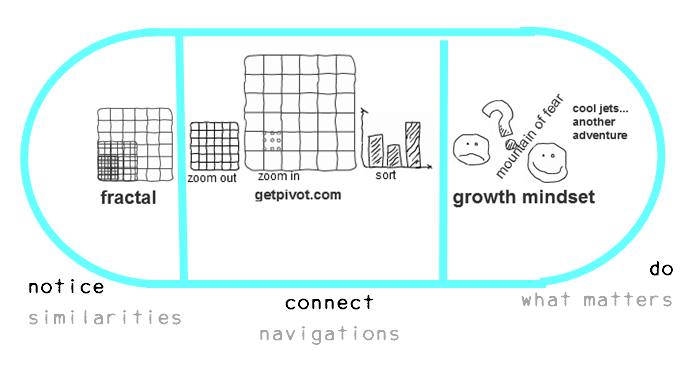
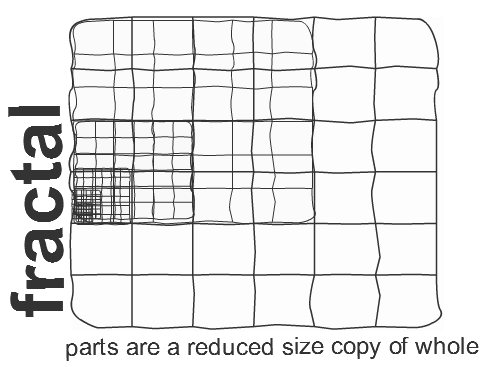
so fractal = emulating a quality
ie: we are all learners... so what i want for my kids, i should be doing, etc

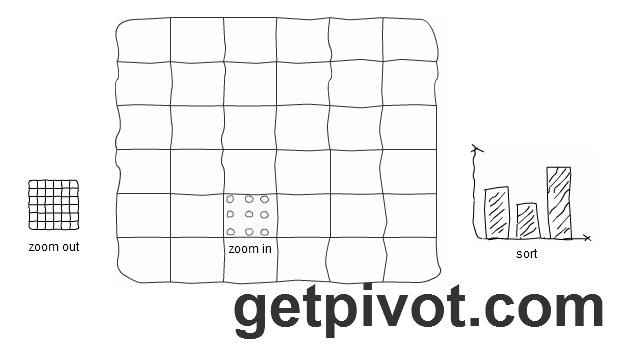
getpivot = ability for a very sophisticated zoom in and zoom out to bring together things you might not otherwise see about what you are learning/doing/noticing/imagining

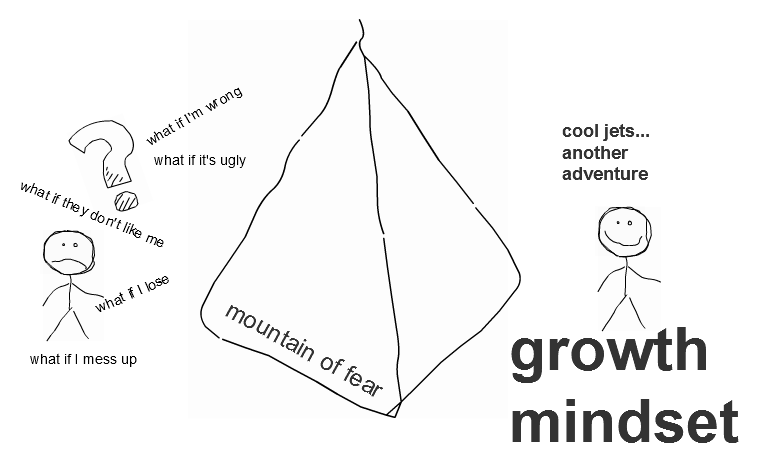
and now mindset = seeing everything as an opportunity for growth
dang - it blew up, cool, what can we learn
wow - i have no idea what to do next, cool , what can we learn
etc.


How do you see things? How do we embrace fear?
Carol Dweck in Mindset suggests we look with wonder for the potential of growth in any situation.


Fractals and getpivot work together nicely if you have the right mindset.
some examples
  • I zoom out and notice a problem more rigorous or more scalable than the one i could only see right before me. I zoom back in and work on the pieces that matter locally. i share it back out.
  • I believe my students should be self-directed learners, I need to model that fractal per my size copy, self-directing my own learning.
  • The Innovation Lab team is an enlarged size copy of my personal learning community as well as a reduced size copy of society.
  • What makes me feel I’ve done something that matters? .. something awesome? How does that relate to my students?


We’re wondering what will happen if we pay more attention to the connections we see when we zoom in and out.
And for the sake of those that aren’t even getting to be a part of all this... (no access for various reasons)
We’re wondering what will happen if we start to officially document/research these connections in a sophisticated, cohesive manner, to find the similarities worth noting and making accessible to all.

One of our goals is that by May we have ample evidence of the rigor and encompassing knowledge/wisdom, that a process based on personalization and self-motivation allows. We’re seeking national validation for reform.

Joe Bower encourages us to ... bring on the students.
So we brought on the students and came up with this.. a standard of access.

Beginning fall 2010 we will piloting this format for documentation of process and we would love for you to join us... because the bigger our base of research, the more valid our stance.

Today’s “school” is an incredible opportunity for rigorous endeavors in things that matter.
An idea that most of us currently (myself included) have honestly no comprehension of.
The new of ed, is the ability to differentiate and specialize to infinity.
We need to model that, we need to do that in education.


2010-2011 school year - we are documenting/crafting/living how to develop/create/ facilitate indispensable people.
  • the government is targeting around 2000 schools to model their plan for transformation.
  • how cool if we could have all our pools of innovation log with us. and then in may 2011 - ask the nation - which one matters more to the student in st louis with no wifi, or to the teacher in philly with no time or money, or to the kid labeled add who really doesn’t want to take those meds....


let’s model for the kids that if we notice something that matters, and we connect with people who have the same idea/desires, and then we do something about it... anything is possible.


___________________________________________________

getpivot.com


  • When Gary Flake disclosed getpivot - he said it will allow us to navigate the web for the first time as if it’s really a web. Zoom out & zoom in iterations & sortings help us make more sense of more info - the whole of data being bigger than the sum of the parts. Tech can provide us visibility in a info maxed and nonlinear world. Gary suggests that this visibility is a new way to ... seek wisdom.
  • Ethan Zuckerman says that interesting problems are global in scale and scope, they require global conversations, not imaginary cosmopolitanism,  ... to get to global solutions.


           is not possible w/o digital tech and
           human generosity.
           He terms this new design resource...

...the ability of the world’s population to volunteer and to contribute and collaborate on large and sometimes global projects.

Getpivot navigation about communities can/will reform ed

i'm not talking the tech in particular - i'm talking the idea behind getpivot... google on steroids.. kind og.
say we collect a massive amount of info.. when we're logging what/how/why people notice, imagine, connect, do... it has to be useable. how do you access what you need from massive amounts of info..
i'm a teacher (but now we're all students) wanting to study specifically how people notice quad formula, - i collect only that data.
i'm a student wanting to study how to connect to people per my passion of fly fishing or musical composition..


________________________________________

fractals


We believe that. We know that. That’s where we have found strength and courage and ideas.
He adds, ...but there is no cohesive integrated structure that amplifies the affect of the research.
That resonated with us.. because that was what we had spent the year questioning and noticing and trying to resolve. How can so many people be doing cool things and still there is no standard change. And still the world is not a place of equity. And still the world has many unsolved and growing problems.
  • In order to make change happen, to make it accessible to everyone, we need to determine the similarities of value that we all want in the end and the similarities of process that make it possible. Not a mandated standardization of content, but rather a discovery of natural serendipitous connections between people. Not a curriculum agenda, or even a student agenda, or even a teacher agenda, or even an admin agenda, ..  a people agenda.


We’re thinking a standard process that allows for personalized learning, no matter the size/color of the copy, is a good fractal. Something that would standardize access to learning rather than specific content to be learned. For everyone.


why the research adds value:
a larger project approved to add credibility to your innovation lab and keep it running in a system designed to clutch to the status quo like Linus of Peanuts fame to his blanket.

______________________________________________


rscon10 - angela maiers

the fun parts are the hard parts

framework for classroom or school wide
1) naming it - around success traits
2) claim traits individual and culture by creating a dream team
3) sustainment


why are these 21st cent skills
 - it's the attention to them that is 21st cent - that they are now the basics


we change today every second - so if you aren't able to emulate these habitudes - you will not have the opportunities available to you today.

ie: emulate how curiosity is cultivated - it's more about the questions you ask
share that she might have 5 questions, but albert would have had 100.. which might find better answers?


 one of her posts - on dream team
then she shares einstein's practice of how to get better at asking questions
her fav pic of einstein:


mine:


the assessment is - who asked the most unique question
which group would albert be the most proud of


Science New: Young Children's 'Theory Of Mind' Linked To Subsequent Metacognitive Development In Adolescence http://www.sciencedaily.com/releases/2008/08/080814154429.htm

cq (curiosity quotient) - will be a factor of your success.
[angela - this was on a kids recommendation for college i filled out for them:


it's not a fight to learn 
21st cent skills - 
but a fight to keep them,
by the time they are 8 years old we have lost half of it.

how to define success - by the habitude quotient


Joan Young(@flourishingkids): We need more longitudinal work to show the value of what we do
jackiegerstein: Can't remember the study- kids asked if they are good learners: about 85% kindergarten say yes - high school about 15% - educational malpractice?

---------------------
Joan Young(@flourishingkids): We know that these things matter long term. Unfortunately lots of research does not reveal because it shows up in adulthood, not on test scores

kids don't have the 21st cent skills because we haven't told them that is what we value

Cathy (@Stutz01): How many teachers/admin have high CQs?

---------------------
Joan Young(@flourishingkids): It's very sad that even in many Kindergarten classes we are pressured to do things that kill the curiosity..too much paper/pencil..not enough play and think time

---------------------
barblcohen: These questions remind me of Michael Wesch's urge to turn students into meaning makers

---------------------
@ryanbretag: @Knowclue very much - it is a situation where we've swayed it to hearing about experiences not engaging in experiences. This needs to shift drastically

angela's student's portrait of his brain on fire...


he asked her if she noticed anything different about him.. then he said - my brain is bigger...
that is an assessment. that's a future ceo, a future world-changer


self-monitoring commitment and development

the gap is not an intelligence gap
it is underestimating our ability gap
ours, the kids, etc.


jackiegerstein: The Genius in All of Us - by Shenk http://geniusblog.davidshenk.com/

---------------------
Kristina @Mrskmpeters: @Jaki Angela's slideshare account

---------------------
Maria João: See the presentation from George Couros, from yesterday. Other words, the same mensage  

---------------------
@trudynorton: And our testing stifles genius....

---------------------
leeannspillane: interesting creativity studies on genius vs hardworking nature of students

---------------------
Moderator (Shelly Terrell): I've seen students stumped by this statement because no one ever told them they were genius or believed in them

---------------------
Joan Young(@flourishingkids): Its about that efficacy..believing you can

curiosity and genius can be taught... they are not casual about what they have been given

innovation = disruption of what we considered as practice
so best practice is not such a great term to be using..
if we don't model learning, the struggle of it, every day, then 
teacher: make someone else better than yourself


_________________________________________


craig robinson

local expert tutor...providing videos to connect math to real life.. such a great zoom out for kids lost in the details. (beautiful details, but details nonetheless..)
how cool is this:


here's all three:

Use of the Quadratic Equation in Genetics
Use of the Quadratic Equation in Ballistics
Use of the Quadratic Equation in Modelling Dynamic Systems


love it - sit back and catch the flavor...

__________________________________

simon sinek - movement

 today's post
I have learned that a cause 
must be organic; if it is to 
have an impact it must 
belong to those who join 
the movement and 
not those who lead it. 

80% of people don't love what they do...to create a world in which the vast majority of people wake up everyday inspired.

Katie has taken this cause and made it her own. She started a website called liveyourwhy.com to collect stories of people who have found their Why.


_____________________________

Monday, August 2, 2010

rscon10


are...


presenting at the symposium.
grazie and bravo.
______________________________________________

school is life

take a listen...
concern over 
switching schools
via @bhsprincipal

what if we never switch schools.. what if we're all one school. just different hubs for face to face.
what if school is real life.
just like no separate discipline.. no separate school.

all learners.

more from Patrick - i need to read.. soon :)
on race to top
on how/why kids learn


 on achievement and success.. 
we are in the habit of linking every report/data collection to  
ability to present specific 
*academic content 
at a given point in time.
we need to get out of that habit.. achievement/success in that sense is not universal.
we're looking into this idea via student insight....


*academic
one dictionary definition reads -  education designed for students who intend to study at a college ( after high school, or attending a school with such courses  ie: she's on the right track)
we're just wondering - right track for what college ... and what career...
_________________________